Kwon Hyunyoung Women's Clinic Doctor's Column
Obstetrics & Gynecology Column

Testing Positive for HPV: What Matters as Much as PDT Laser Treatment?

What decides whether a positive HPV result needs treatment, how PDT photodynamic laser treatment works, and what to manage afterwards.

Published 2026-09-23 Updated 2026-09-23 Reviewed by Hyunyoung Kwon, Medical Director · Obstetrics & Gynecology Specialist

A positive result for human papillomavirus (HPV) makes most people think of cancer straight away, but in practice treatment usually follows only after it is clear the virus is persisting. This article sets out the criteria for follow-up, how PDT works, and what to manage after treatment.

In short, a positive HPV result is not a signal to treat immediately. It is a signal to watch for persistence before deciding, and even after PDT, monitoring has to continue alongside it to reduce the chance of recurrence.

01

If I test positive for HPV, do I need treatment right away?

Key point
Treatment does not begin the moment a positive result arrives. Follow-up testing at intervals of 6 months to 1 year is used to see whether the virus clears on its own, and the decision to treat is made after that. What matters most in that decision is how long the virus persists.

Human papillomavirus is common enough that most women of reproductive age are infected at some point, and it divides into low-risk and high-risk groups that are managed differently. It often clears on its own, but if it persists over a long period it can lead to cervical dysplasia or cervical cancer, which is why the initial assessment and follow-up matter.

In the early period after a positive result, treatment is generally not started automatically. Follow-up testing at intervals of 6 months to 1 year is used to observe whether the virus clears. If it continues to be detected, treatment is considered, and at that point the duration of persistence weighs more heavily than the risk group alone.

Anatomy illustration related to Testing Positive for HPV: What Matters as Much as PDT Laser Treatment?
02

How does PDT photodynamic laser treatment work?

Key point
In PDT, a photosensitising agent is applied to the surface of the cervix and light of a specific wavelength is then directed at it, so that normal cells are preserved while only the infected lesion tissue is selectively destroyed. That selectivity is what separates it from excision.

PDT applies a photosensitising agent to the surface of the cervix and then directs light of a specific wavelength at it, preserving normal cells while selectively destroying the infected lesion tissue. Unlike conization, it preserves normal tissue, so there is less concern about side effects and it remains a stable option for those planning a pregnancy.

In clinical research applying PDT photodynamic treatment to 647 patients with cervical HPV infection, 520 of the 647 (80.4%) had no infection detected at the final follow-up, which is regarded as evidence for it as a non-invasive and safe treatment option.

It does not stop at destroying infected cells. It also removes highly active cells and supports an improved immune response, working to restore the environment within the cervix. By creating conditions in which the body clears the virus itself, it also helps to lower the rate of recurrence.
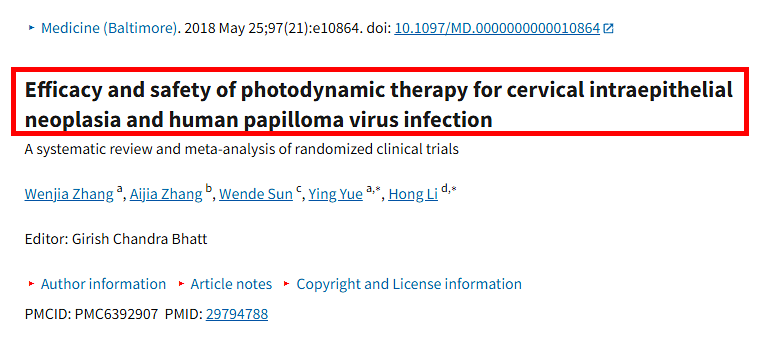
Research material related to Testing Positive for HPV: What Matters as Much as PDT Laser Treatment?
Related research
03

When is PDT treatment needed?

Key point
PDT comes into consideration when high-risk HPV is repeatedly detected, when the virus persists for 1 to 2 years or longer, when cervical dysplasia has reached stage 1, or when genital warts keep returning after treatment.

The point at which treatment is needed differs from person to person, and the clinician decides by weighing the risk level of the virus, how long it has persisted and the state of the lesion together. In the situations below, active treatment is worth considering before matters progress further.

  • Multiple detections of high-risk HPV (types 16 and 18) — when higher-risk types are confirmed repeatedly, treatment is actively considered
  • HPV persisting 1 to 2 years — the virus has not cleared on its own and keeps being detected over 1 to 2 years
  • Cervical dysplasia at its earliest stage (CIN1) — an early lesion in which cell changes have already begun
  • Recurring genital warts — including cases where warts keep returning after treatment
04

What needs managing after PDT treatment?

Key point
One course of laser treatment is not a reason to stop paying attention. Depending on the size and position of the lesion and the symptoms, further treatment may be needed, so monitoring before and after treatment has to continue as part of the plan.

HPV is a persistent virus, and a single course of laser treatment is not in itself a reason for reassurance. The number of sessions may increase according to risk, including the size and position of the lesion confirmed clinically and the symptoms, so monitoring that does not miss small changes before and after treatment matters.

  • Regular monitoring — follow-up so the window in which the photodynamic laser responds well is not missed, and confirmation afterwards of whether the virus has cleared
  • Supporting treatment alongside — where the laser alone is not enough, vaginal suppositories, nutritional support and additional immune care can run in parallel
  • Vaccination guidance — where appropriate, guidance on vaccination such as Gardasil can lower the risk of reinfection

Hyunyoung Kwon, Medical Director
Doctor's view

How the doctor decides

Hyunyoung Kwon, Medical Director · Obstetrics & Gynecology Specialist

I do not let small changes slip past

If a member of my own family had a positive HPV result, the first thing I would tell them to check is whether the clinic monitors closely enough not to miss small changes. I follow patients so the window in which the photodynamic laser responds well is not missed, and after treatment I regard monitoring for whether the virus has cleared as the most important part.

I do not judge by the laser alone

There are cases where laser treatment on its own is not enough, so where it is needed I also consider vaginal suppositories, nutritional support and additional immune care. When a lesion responds slowly, I review the overall management before increasing the number of sessions.

I see vaccination as part of my role

Where it is appropriate, I consider guiding a patient toward Gardasil vaccination to be part of what a doctor caring for women should do.

I watch how each patient responds

Recovery and general condition differ for each patient, so I check them continually and try to build a strategy suited to that individual. The same diagnosis does not mean the same approach.

Summary

In summary

A positive HPV result does not mean cancer, but because it is a signal from the body it deserves close attention and a response. Whether treatment is needed depends on how long the virus persists, so follow-up testing should not be neglected, and where persistent infection is confirmed it is better to combine PDT treatment with ongoing management.

FAQ

Frequently asked questions

QDoes a positive HPV result always need treatment?
A

No. Follow-up testing at intervals of 6 months to 1 year is used first to see whether the virus clears, and treatment is considered if it continues to be detected.

QHow does PDT differ from conization?
A

Conization removes the lesion surgically, while PDT uses light and a photosensitising agent to destroy only the infected tissue, preserving normal tissue.

QHow effective is PDT treatment?
A

In clinical research, 520 of 647 patients with HPV infection (80.4%) had no infection detected at the final follow-up.

QCan I skip testing after treatment?
A

No. Further treatment may be needed depending on the state of the lesion, so monitoring before and after treatment should continue.

QAre recurring genital warts also treated this way?
A

Yes. Along with repeated detection of high-risk HPV, persistence of 1 to 2 years or more and stage 1 dysplasia (CIN1), they are among the main situations in which PDT is considered.

Hyunyoung Kwon, Medical Director
Medical review
Hyunyoung Kwon, Medical Director · Obstetrics & Gynecology Specialist
This content is general medical information and may not apply to every individual. Diagnosis and treatment are decided through a consultation.