Kwon Hyunyoung Women's Clinic Doctor's Column
Obstetrics & Gynecology Column

Severe Period Pain: How Do Uterine Fibroids and Adenomyosis Differ?

How uterine fibroids and adenomyosis differ, how they are told apart, and the practical criteria that decide the direction of treatment.

Published 2026-10-09 Updated 2026-10-09 Reviewed by Hyunyoung Kwon, Medical Director · Obstetrics & Gynecology Specialist

Some people who see a doctor for severe period pain are diagnosed with uterine fibroids or adenomyosis. The names are similar, so the two are easily mistaken for the same condition, but they differ completely in where they arise and in their nature, and different criteria apply when deciding on treatment.

In short, for both conditions surgery is rarely considered at the moment of diagnosis. The usual approach is to start with medication and hormone treatment, according to how severe the symptoms are and whether a pregnancy is planned.

01

How do uterine fibroids and adenomyosis differ?

Key point
The difference lies in this: uterine fibroids are common benign lumps that form in the muscle of the uterus, whereas adenomyosis is a condition in which tissue from the uterine lining grows into the muscle layer, so that the wall of the uterus becomes thicker.

A uterine fibroid is a lump that forms in the muscle of the uterus. It is a common benign tumour, experienced by 40 to 50% of women of reproductive age, and it causes period pain and heavy menstrual bleeding. Depending on where it forms, it is classed as intramural, subserosal or submucosal, and the symptoms differ accordingly.

Adenomyosis is not a lump. It is a condition in which tissue from the uterine lining grows into the muscle layer, making the uterine wall thicker. It causes lower abdominal pain and very heavy periods, and it interferes with implantation, raising the risk of infertility. In many cases the pain is severe enough that painkillers do little to relieve it.

  • Intramural fibroids — at 5cm or larger, they can cause heavy periods and dizziness from anaemia
  • Subserosal fibroids — as they grow, they press on the bladder, causing frequent urination or a feeling of fullness
  • Submucosal fibroids — even when small, they interfere with implantation and raise the risk of infertility
02

How are uterine fibroids and adenomyosis told apart?

Key point
On an ultrasound scan, a uterine fibroid shows up as a rounded lump that bulges outward, while in adenomyosis the whole uterus appears swollen and enlarged. The intensity of period pain and the pattern of bleeding also differ clearly from one condition to the other.

The two conditions are distinguished by whether there is a lump or tissue invasion, by the intensity of period pain, by the pattern of bleeding and by ultrasound findings. Uterine fibroids can also bring period pain and changes in menstrual flow, but adenomyosis is characterised in almost all patients by a sharp increase in bleeding and pain that painkillers do little to relieve.

Neither can be said with certainty to be more dangerous, but adenomyosis needs careful management because its symptoms are more pronounced and it interferes with implantation more readily. Research has also found that pelvic pain is greater when the two conditions occur together.
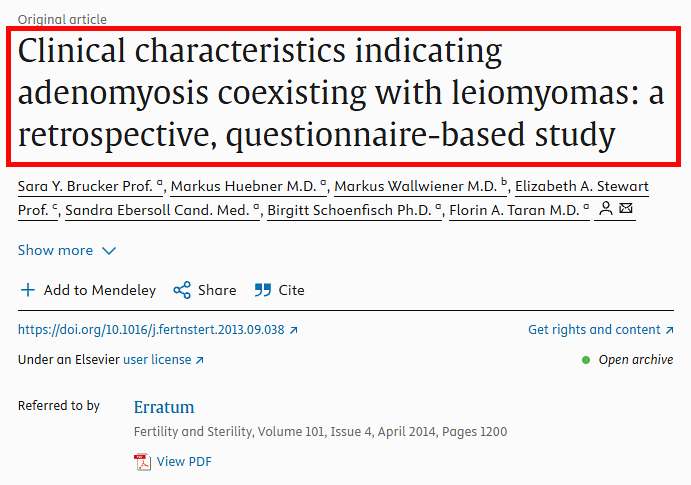
Research material related to Severe Period Pain: How Do Uterine Fibroids and Adenomyosis Differ?
Related research
03

What problems arise when uterine fibroids and adenomyosis occur together?

Key point
A study that looked at 560 people in total found that 159 of them had both conditions, while the other 401 had uterine fibroids alone. When the two groups were compared, the women who had both conditions together showed higher pelvic pain scores than those with fibroids alone.

In a study that examined cases in which adenomyosis and uterine fibroids occurred together, 159 of 560 participants in total had both conditions and the remaining 401 had uterine fibroids alone. Higher pelvic pain scores were reported in the women who had both conditions.

Left untreated, this can lead to the problems below appearing together, so it is important to assess the clinical symptoms accurately before deciding on treatment. When the two conditions overlap, management can become more difficult the longer they are left untreated.

  • Heavy menstrual bleeding and anaemia — bleeding increases and can lead to anaemia, causing dizziness
  • Chronic pelvic pain — pain continues regardless of the cycle and can interfere with daily life
  • Higher risk of infertility — interference with implantation can affect pregnancy plans
  • More complex treatment — deciding on the direction of treatment becomes more difficult
04

What criteria decide the treatment?

Key point
The decision does not start from surgery; it is based on age, how severe the symptoms are and whether a pregnancy is planned. Even when pain or bleeding is severe, the usual approach is to control the condition first with medication and hormone treatment.

Even for the same condition, the treatment plan differs according to age, the severity of symptoms and pregnancy plans, and even when pain or bleeding is severe, medication and hormone treatment are generally tried first. For adenomyosis, a Mirena device can be placed in the uterus to reduce pain and menstrual flow.

For anyone planning a pregnancy, aggressive surgery can weaken the uterine wall and lead to a risk of uterine rupture, so restoring the uterine environment with hormone treatment is the safer approach. Surgery is the last option, decided on when medication does not control the condition and fertility preservation has been taken into account.

Hyunyoung Kwon, Medical Director
Doctor's view

How the doctor decides

Hyunyoung Kwon, Medical Director · Obstetrics & Gynecology Specialist

I do not recommend surgery by default

I do not recommend surgery straight away just because someone has been diagnosed with uterine fibroids or adenomyosis. I first check how severe the symptoms are and whether a pregnancy is planned, and my priority is to see whether medication and hormone treatment can control the condition.

I put preserving fertility first

For anyone planning a pregnancy, my judgement is that aggressive surgery can weaken the uterine wall and affect later pregnancies. So I first look at controlling symptoms with hormone treatment and stabilising the uterine environment.

I also check whether both are present

I also check carefully whether uterine fibroids and adenomyosis are present together. I take into account that pelvic pain can be greater when the two occur together, and after assessing the clinical symptoms I suggest a treatment direction that differs for each patient.

I keep surgery as the last option

I review surgery only when symptoms are not controlled despite several medications, there is no pregnancy plan, and the question of preserving fertility has been fully weighed. Even without symptoms, problems can grow if care is neglected, so I recommend regular follow-up.

Summary

In summary

Uterine fibroids and adenomyosis have similar names but differ in where they arise and in their nature. The direction of treatment also depends on the severity of symptoms and pregnancy plans. Because pelvic pain can be greater when the two occur together, period pain that is unusually severe or not controlled by painkillers should not be ignored, and it is worth seeing a doctor.

FAQ

Frequently asked questions

QCan uterine fibroids and adenomyosis be diagnosed at the same time?
A

Yes, they can occur together. In a study of 560 people, 159 had both conditions.

QDo uterine fibroids always need surgery?
A

No. Depending on symptoms and pregnancy plans, medication or hormone treatment is used first to control them, and surgery is the last option.

QWhat can be done about adenomyosis when a pregnancy is planned?
A

Aggressive surgery can weaken the uterine wall. Symptoms can be controlled with a Mirena device or hormone treatment.

QIs a small uterine fibroid nothing to worry about?
A

It depends on the location. A submucosal fibroid can interfere with implantation and raise the risk of infertility even when small.

QWhat tests are done for severe period pain?
A

An ultrasound checks whether there is a lump or the whole uterus is swollen, and the intensity of period pain is also assessed.

Hyunyoung Kwon, Medical Director
Medical review
Hyunyoung Kwon, Medical Director · Obstetrics & Gynecology Specialist
This content is general medical information and may not apply to every individual. Diagnosis and treatment are decided through a consultation.