When periods have been absent for several months, the first worry is often early menopause. Ongoing absence of periods is not enough on its own to conclude that menopause has arrived, and tests to identify the exact cause come first.
In short, it has not been 100 percent confirmed that ovarian function has completely ended, and with treatment and monitoring, the chance of pregnancy and overall health can be managed together. This article sets out the testing process and the direction of treatment.
If my periods stay absent, is it early menopause right away?
Absent periods alone do not lead to a diagnosis. The first step is to confirm when the cycle began to change; blood tests then repeatedly monitor follicle-stimulating hormone (FSH) and oestrogen levels, and ultrasound checks the number of antral follicles to gauge the state of the ovaries.
If periods return regularly every month and ovulation occurs normally, the ovaries can be regarded as currently doing their job even if the levels come back low, so there is no need to rush to a conclusion from one test result alone.
- Checking the menstrual cycle and pattern — how many months the absence of periods has lasted, looking back to when the cycle became irregular
- Blood tests (FSH, oestrogen) — hormone levels are measured repeatedly to gauge how far ovarian function has declined
- Ultrasound (antral follicle count, AFC) — the number of eggs prepared for ovulation is checked to assess remaining function
With premature ovarian insufficiency, is pregnancy impossible?
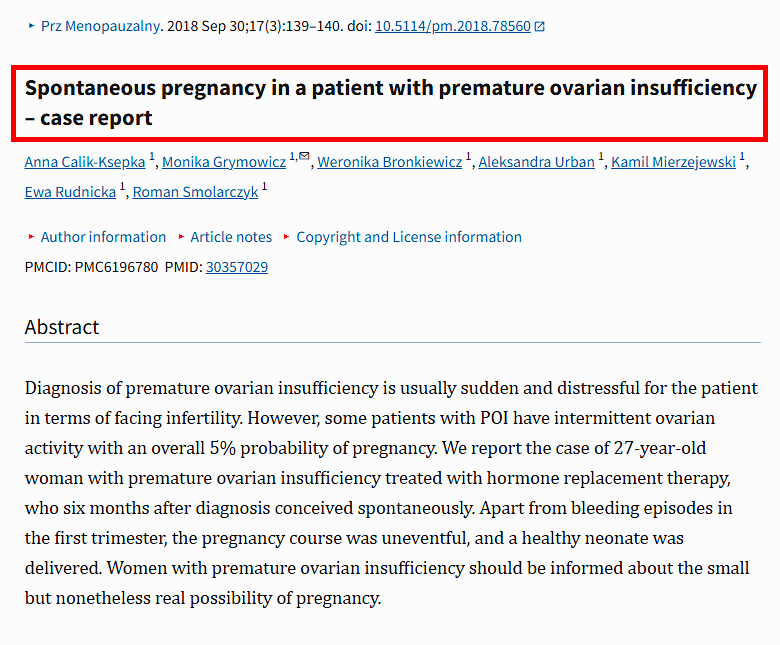
This diagnosis does not mean that function has stopped altogether; it refers to a state in which the ovaries are not working properly, and cases are reported in which remaining follicles lead to natural pregnancy. One case report describes a 27-year-old woman on hormone replacement therapy who conceived naturally 6 months after diagnosis and gave birth to a healthy baby.
However, because ovulation occurs only intermittently, the overall chance of pregnancy is lower, so a realistic approach is to control the remaining follicles with ovulation-inducing medication or hormone treatment to raise the success rate.
How is treatment carried out?
Within limits that do not place a burden on the body, ovulation-inducing medication may be used to time attempts at natural pregnancy, and if the uterus is judged unlikely to provide a suitable environment for pregnancy, a strategy based on egg retrieval or embryo freezing may be planned.
Because ovulation can still occur intermittently, which treatment is needed at which point shifts little by little, so regular monitoring is important, and when a procedure is needed, the key is not to miss the critical window.
- Hormone levels — whether ovulation-inducing medication is used, and at what strength, depends on the levels
- Uterine and ovarian condition — different strategies are considered depending on how suitable the environment is for pregnancy
- Pregnancy plans and age — these change the order and timing of trying for natural pregnancy versus preparing other methods
Is treatment needed even without plans for pregnancy?
When ovarian function declines, female hormone secretion falls, bone density decreases and can lead to osteoporosis, and the risk of cardiovascular conditions such as hyperlipidaemia and dyslipidaemia rises, so using hormone replacement therapy until 50, the age of natural menopause, is recommended.
Where vaginal dryness or atrophic vaginitis appears, laser treatment may also be used alongside, and including treatment that prevents these complications is a way of preparing for health 10 and 20 years later.
- Osteoporosis — as bone density decreases, the risk of weakened bones grows
- Dyslipidaemia and hyperlipidaemia — lipid levels become unbalanced and the risk of cardiovascular disease rises with them
- Vaginal dryness and atrophic vaginitis — these appear as the lining thins with falling hormones, and laser treatment is sometimes used alongside