Kwon Hyunyoung Women's Clinic Doctor's Column
Obstetrics & Gynecology Column

Menopause Hormone Therapy: Is the Same Medication Prescribed for Everyone?

Why menopause treatment is needed even when symptoms are mild, and the criteria used to decide the medication and duration of hormone therapy.

Published 2026-10-26 Updated 2026-10-26 Reviewed by Hyunyoung Kwon, Medical Director · Obstetrics & Gynecology Specialist

Many women hesitate over menopause treatment because they have heard that hormone therapy is dangerous or that it increases breast cancer. This article covers why menopause treatment is needed even when symptoms are mild, and the criteria used to decide the medication and the duration. In short, menopause treatment is not a matter of giving everyone the same medication; it is a process of deciding individually according to age, whether the uterus is present and medical history, and then adjusting while watching the response.

01

Is menopause treatment needed even when symptoms are not severe?

Key point
Having little discomfort does not mean there is no problem. When oestrogen declines, the risks of myocardial infarction and stroke, osteoporosis, and metabolic diseases such as abdominal obesity and diabetes rise together, which is why menopause treatment is a process of preparing for health in later life.

As menopause approaches, the secretion of oestrogen and progesterone gradually decreases, and menopausal symptoms begin as that change affects the function of the autonomic nervous system. The body stays in a constant state of tension, which brings palpitations and anxiety. The face flushes hot, and changes also appear in the regulation of body temperature, sleep and mood. Some women experience vaginal dryness or atrophic vaginitis.

Even when menopausal symptoms are mild, the decline in the role of oestrogen continues inside the body all the same. The ability to protect the blood vessels falls, so the incidence of cardiovascular and cerebrovascular disease rises. The activity of osteoclasts, the cells that break down bone, increases and exposes the body to the risk of osteoporosis, and as insulin sensitivity decreases, the proportion of abdominal fat increases as well.

  • Myocardial infarction and stroke — the ability to protect the blood vessels declines, and the incidence of cardiovascular and cerebrovascular disease rises
  • Osteoporosis — osteoclast activity increases, exposing the body to the risk of weaker bones
  • Metabolic disease — insulin sensitivity decreases, and the risk of abdominal obesity and diabetes grows
02

Is hormone therapy a dangerous treatment?

Key point
A paper from the North American Menopause Society regards hormone therapy as the most effective treatment for vasomotor symptoms, genitourinary syndrome, and the prevention of bone loss and fractures. It stresses, however, that the risks differ with dose, type, duration of use, route of administration and timing of initiation, so individualised assessment and prescription are needed.

Hormone therapy is used to supplement the female hormones that have become deficient, with the aim of relieving symptoms and preventing complications, and menopause treatment is broadly divided into hormonal therapy and non-hormonal therapy. The North American Menopause Society's paper on hormone therapy, published in The Journal of The Menopause Society, also acknowledges its effectiveness while pointing out that the risks of the same medication change with the way it is used.

When oestrogen alone is given over a long period, the endometrium is continuously stimulated, proliferates and becomes hyperplastic, which increases the risk of cancer, so progesterone is prescribed in combination for women who have a uterus. Conversely, women with a past hysterectomy have no risk of endometrial proliferation, so oestrogen can be prescribed alone.
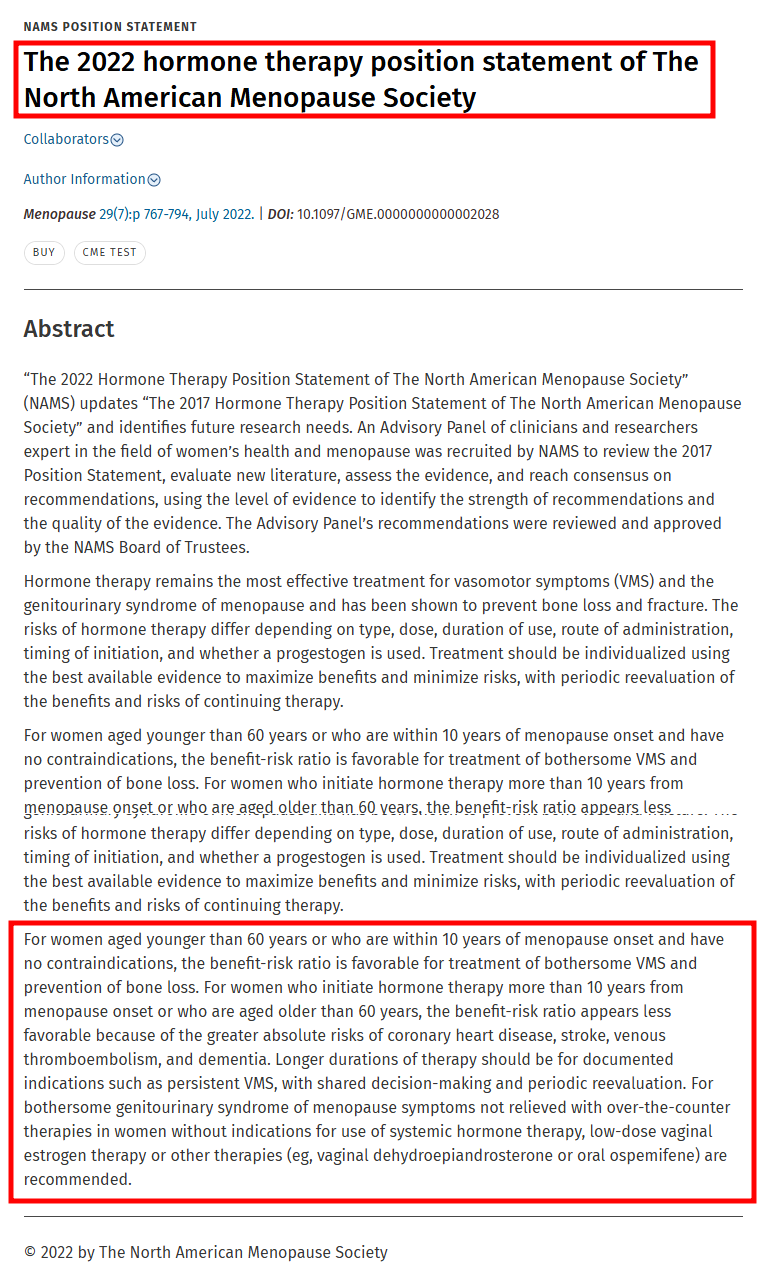
Research material related to Menopause Hormone Therapy: Is the Same Medication Prescribed for Everyone?
Related research
03

What criteria decide the medication and duration of hormone therapy?

Key point
The type of medication and the length of treatment are decided by weighing the severity of symptoms, whether the uterus is present, any history of breast cancer, blood clots or cardiovascular disease, the expected duration of use, and the response to the hormone preparation. The key is adjusting to the response rather than insisting on the initial plan.

Age and the time that has passed since menopause are also important criteria for choosing a medication. Oestrogen has a protective effect before the age of 60, but when changes in the blood vessels and bones have already progressed, as in a 65-year-old woman whose menopause came more than 10 years ago, the synthesis of proteins related to blood clotting increases and the likelihood of clot formation rises, so it is preferable to consider the systemic risk and use a different medication as an alternative.

Menopause treatment does not mean keeping one prescription unchanged to the end. It is a process of adjustment in which the patient's response is checked at regular intervals, the dose is reduced or increased, the formulation is changed, and treatment is switched to non-hormonal therapy if necessary. When vaginal dryness or urinary incontinence is prominent, procedures such as laser or injection treatment are sometimes combined.

  • Presence of the uterus — if the uterus is present, progesterone is combined; if it is not, oestrogen alone is possible
  • History of breast cancer, blood clots or cardiovascular disease — this serves as the basis for gauging the systemic risk of hormone medication
  • Response to hormone medication — dose adjustment, a change of formulation or a switch to non-hormonal therapy is decided after watching the course

Hyunyoung Kwon, Medical Director
Doctor's view

How the doctor decides

Hyunyoung Kwon, Medical Director · Obstetrics & Gynecology Specialist

I do not say "it is all the same medication in the end"

The way menopause presents varies enormously from person to person, so the time treatment starts, the state of health and the presence of systemic disease are all different. That is why I first check the severity of symptoms, whether the uterus is present, and any history of breast cancer, blood clots or cardiovascular disease, and then decide the type and ingredients of the medication and how long it is taken. Hormone therapy is a treatment that has to be chosen carefully.

I ask first about the response to the last prescription

In the consulting room, I first ask "How did you feel after taking the last medication?" and "Which symptom is bothering you most right now?" I explain which symptom the ingredients in today's medication are meant to help, start with a low dose, and then adjust while watching the course. Only with enough explanation can the patient feel less anxious and watch for side effects together with me.

I see menopause treatment as preparation for health in later life

I am also someone who watched my own parents pass through this stage of life, so I can appreciate how hard that time feels. Even so, as a doctor I tell patients that the life ahead differs according to how they have come through menopause and the menopausal transition. That is the reason I look at blood vessel, bone and metabolic health together even when the symptoms are not severe.

Summary

In summary

Menopause treatment goes beyond relieving symptoms; it is a process of preparing for cardiovascular and cerebrovascular disease, osteoporosis and metabolic disease. Hormone therapy has a clear effect, but the medication and duration have to be decided differently according to age, whether the uterus is present and medical history. If hot flushes, changes in sleep or vaginal dryness continue, or if menopause is approaching, an obstetrics and gynaecology visit is advisable to confirm the direction of treatment.

FAQ

Frequently asked questions

QDoes hormone therapy always raise the risk of breast cancer?
A

The society's paper explains that the risks of hormone therapy differ with dose, type, duration of use, route of administration and timing of initiation. Individual conditions such as a history of breast cancer are therefore assessed first, and then whether and how to prescribe is decided.

QDoes the hormone medication change after a hysterectomy?
A

Without a uterus there is no risk of endometrial proliferation, so oestrogen can be prescribed alone. When the uterus is present, progesterone is combined to protect the endometrium.

QCan hormone therapy be started at an older age?
A

Oestrogen has a protective effect before the age of 60, but after that the likelihood of clot formation rises. When blood vessel changes have progressed, as at 65 with more than 10 years since menopause, a different medication is considered as an alternative.

Hyunyoung Kwon, Medical Director
Medical review
Hyunyoung Kwon, Medical Director · Obstetrics & Gynecology Specialist
This content is general medical information and may not apply to every individual. Diagnosis and treatment are decided through a consultation.